Episode Overview
“Mojave Morning” opens Season 2 with aftermath, pursuit, and consequences already in motion. The desert isn’t a backdrop, it’s a judge.
Control
Who has it, who thinks they have it, and who never did. Vault-Tec’s favorite illusion.
Memory
Accurate, distorted, weaponized. The Ghoul remembers what cities pretend to forget.
Momentum
Season 2 doesn’t ask permission. Events are already rolling downhill.
The Mojave
Not nostalgia. Not scenery. A proving ground that strips context from everyone.
Introduction: The Sun Rises on a Changed Wasteland
Every season of Fallout begins with a lie. Not always a spoken one, but a structural lie: a belief the world once held, now broken. In Season 1, the lie was safety. Vaults promised protection, civilization promised order, and the idea that humanity could simply wait out the apocalypse felt comforting. By the end of that season, the lie was exposed. Safety was conditional. Order was curated. Survival was never evenly distributed.
Season 2 opens with “Mojave Morning”, an episode that feels deliberately restrained yet quietly aggressive in its intent. There is no bombastic set piece to announce its arrival. Instead, the episode opens with space, heat, distance. The Mojave stretches endlessly, indifferent to the personal stakes of the people crossing it. This is a story about aftermath, momentum, and consequences already rolling downhill.
Declassification Summary
If Season 1 was about revelation, Season 2 begins with pursuit.
The Mojave as a Character, Not a Backdrop
The Mojave Desert is not interested in heroism. The episode lingers on wide shots, on horizons that refuse relief, on a sun that is not romanticized but oppressive. The desert here is not a playground or a postcard. It is a proving ground. Every character introduced into this environment is stripped of context. Titles mean nothing. Allegiances are invisible. Survival becomes the only language spoken fluently.
By choosing to open Season 2 here, the show makes a statement: the wasteland does not care what you learned last season.
Lucy MacLean: Optimism Under Heat Stress
Lucy enters the episode with purpose. She is no longer wandering; she is chasing answers and chasing her father. But purpose does not equal clarity. Her defining trait has always been empathy, and “Mojave Morning” treats empathy as both asset and liability. She approaches a settlement openly, offers help, and speaks plainly. The response is suspicion, not cruelty: conditioning. The wasteland has taught its inhabitants that generosity is often bait.
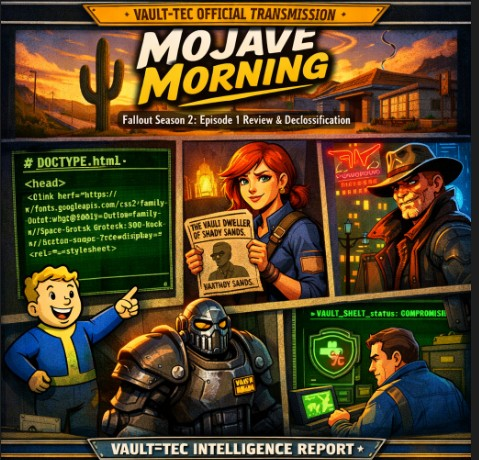
The bounty poster is an emotional pivot. The image is crude, weathered, impersonal. It strips Hank MacLean of identity and replaces it with a title and a price. Lucy’s reaction is conflict rather than shock. Her belief collides with evidence suggesting her father is being hunted and possibly deserves to be.
Vault-Tec Field Guidance
Good intentions do not shield you from consequences.
Hank MacLean: The Man Who Knows Too Much
Hank appears sparingly, but his absence dominates. Rumors contradict each other: polished, paranoid, wealthy, dangerous, helpful, disposable. This ambiguity is intentional. Hank is no longer a character in the traditional sense; he is a variable. His trail suggests resources and networks that should not exist naturally. He is not surviving by chance. He is navigating a system he may have helped design.
Season 2 quietly reinforces a disturbing idea: Vault-Tec’s influence did not end with the Great War. It changed form.
The Ghoul: Memory as a Weapon
The Ghoul is already in motion. No re-introduction needed. He remembers. Memory is his advantage and his curse. His hunt through New Vegas feels less like a job and more like ritual: familiar spaces repurposed, degraded, misunderstood by everyone except him. The city pretends to remember the old world while actively misreading it.
He speaks minimally. Dialogue is currency. He spends it sparingly. He could kill more. He chooses not to, and that restraint suggests purpose beyond profit.
New Vegas: Nostalgia with Teeth
This is not New Vegas as a triumphant monument. It is a place after entropy. Power exists, but fractured. Order exists, but inconsistent. Every bar feels like compromise, every deal temporary. The episode draws a parallel between The Ghoul and the city itself: both remnants sustained by habits that no longer serve them.
New Vegas is not dying. It is decaying strategically.
Maximus: Rank Without Relief
Maximus begins Season 2 in armor, but the armor does not protect him. His promotion to Knight becomes burden rather than relief. Authority in the Brotherhood is obligation. Squire Pip mirrors the Maximus of last season: enthusiastic, idealistic, unscarred. That reflection is pressure.
The G.E.C.K. mission is not framed as miracle, but bargaining chip: a symbol of control. Maximus questions silently, obeys mechanically, and his doubts leak through. He hasn’t rebelled yet. But the seed is planted.
Norm MacLean: Knowledge as Isolation
Norm remains trapped, and Vault 33 has grown quieter rather than safer. His storyline leans psychological: sealed tunnels, hidden terminals, fragmented logs. The episode suggests the experiments were not isolated but systemic. Norm’s tragedy is not learning the truth. It is learning it alone.
> ACCESSING_ENCRYPTED_LOGS…
> VAULT_SHELT_STATUS: COMPROMISED
> SUBJECT_NORM: OBSERVATION_ACTIVE
Vault-Tec: The Ghost in Every Machine
“Mojave Morning” doesn’t center Vault-Tec overtly. It lets the corporation haunt the narrative: Hank’s resources, Norm’s logs, the Brotherhood’s relic obsession, Lucy’s upbringing. Vault-Tec’s greatest success wasn’t the vaults. It was selling the myth that survival could be standardized.
Season 2 begins dismantling that myth. The vaults didn’t save humanity. They curated it.
Final Assessment: A Calculated Opening Move
“Mojave Morning” is not designed to impress casually. It is designed to endure scrutiny. It trusts the audience to notice details, connect threads, and sit with discomfort rather than demand spectacle. Season 2 doesn’t announce itself loudly. It advances deliberately, like a hunter, like a corporation that planned for the end of the world and is still collecting dividends.
Vault-Tec Reminder
The future is already written. You’re just living in the margins.
Featured Dossiers
Declassified personnel files from Mojave Morning. Click to explore character profiles and mission data.

Lucy MacLean
Vault Dweller • Field Asset
Active
Optimism under stress, evolving without losing the core. The wasteland tests her values like a pressure chamber.

The Ghoul
Bounty Hunter • Pre-War Echo
Immortal
Memory sharpened into a blade. He navigates neon decay like he built it, and wastes no words unless they cut.

Maximus
Brotherhood Knight • Doubt Engine
Assigned
Rank arrives, relief does not. Authority becomes a cage when you realize a squire is also a witness.

Hank MacLean
Runaway Executive • Key Variable
Wanted
Rumors disagree because he’s not leaving a trail, he’s curating one. Clean suits often carry dirty keys.

Norm MacLean
Vault 33 • Terminal Diver
Access
Knowledge isolates faster than walls. The deeper he reads, the smaller his world becomes.